Fluroxene
| Fluroxene | |
|---|---|
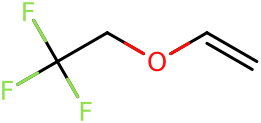 | |
| Molecular structure via molpic based on CDK |
| Rotamer [] | |
|---|---|
| Conformer structure via 3Dmol.js |
| Physical properties [] | |
|---|---|
| Molecular mass | 126.08 g/mol [1] |
| Density | 1.14 (NIOSH, 2024) - Denser than water; will sink g/cm3 [1] |
| Boiling point | 109 ° [1] |
| Predicted LogP | 1.9 [1] |
| Structural Identifiers [] | |
|---|---|
| Molecular formula | C4H5F3O [1] |
| IUPAC name | 2-ethenoxy-1,1,1-trifluoroethane [1] |
| SMILES | C=COCC(F)(F)F [1] |
| InChI | InChI=1S/C4H5F3O/c1-2-8-3-4(5,6)7/h2H,1,3H2 [1] |
| InChIKey | DLEGDLSLRSOURQ-UHFFFAOYSA-N [1] |
Fluroxene (also known as 2,2,2-Trifluoroethyl vinyl ether, Fluoromar, Ethene, (2,2,2-trifluoroethoxy)-, Flurossene, NSC-760364, fluoroxene, 2,2,2-Trifluoroethoxyethene, 206-977-1, (2,2,2-Trifluoroethoxy)ethene or Fluroxeno) is a
Chemistry
Stereochemistry []
Fluroxene is a achiral mixture.
Legal status []
- United States: Fluroxene is a }-}
'''Fluroxene''' (International Nonproprietary Name|INN, United States Adopted Name|USAN; brand name '''Fluoromar'''), or '''2,2,2-trifluoroethyl vinyl ether''', is a Inhalational anesthetic#Volatile anesthetic|volatile, inhalational anesthetic. It was synthesized in 1951, and was introduced for clinical use in 1954, but was voluntarily withdrawn from the market in 1974 due to its potential flammability and accumulating evidence that it could cause organ (biology)|organ toxicity. In any case, prior to being discontinued, it had largely been superseded by halothane. Fluroxene is metabolized to 2,2,2-trifluoroethanol, a compound responsible for some of the toxicity seen with fluroxene use.
== See also ==
- Divinyl ether
- Thiomethoxyflurane
== References == {-{Reflist|2}-}
{-{General anesthetics}-} {-{GABAAR PAMs}-}
Category:General anesthetics Category:GABAA receptor positive allosteric modulators Category:Trifluoroethyl compounds Category:Vinyl ethers
See also []
External links []
References []
National Center for Biotechnology Information. PubChem Compound Summary for CID 9844, Fluroxene. Accessed August 24, 2026. https://pubchem.ncbi.nlm.nih.gov/compound/9844
U.S. Food and Drug Administration; National Center for Advancing Translational Sciences. Fluroxene. UNII: FO7JHA3G03. Global Substance Registration System. Accessed August 24, 2026. https://gsrs.ncats.nih.gov/ginas/app/beta/substances/FO7JHA3G03
Stoelting RK, Hillier SC. Pharmacology and Physiology in Anesthetic Practice. Lippincott Williams & Wilkins. January 11, 2012.
Jakob AK, Kopp SL, Bacon DR, Smith HM. Clinical Anesthesia. Lippincott Williams & Wilkins. January 1, 2011.
Lichtiger M, Moya F. Introduction to the practice of anesthesia. Medical Dept., Harper & Row. January 1, 1978. Accessed August 24, 2026. https://books.google.com/books?id=ecZpAAAAMAAJ
Acta anaesthesiologica Belgica. Acta Medica Belgica }. Accessed August 24, 2026. https://books.google.com/books?id=KmsxAAAAIAAJ
Fiserova-Bergerova V. Metabolism and toxicity of 2,2,2-trifluoroethyl vinyl ether. Environmental Health Perspectives. December 1, 1977; 21:225–230.
Kaminsky LS, Fraser JM. Multiple aspects of the toxicity of fluroxene and its metabolite 2,2,2-trifluoroethanol. Critical Reviews in Toxicology. 19(2):87–112.