Iproheptine
| Iproheptine | |
|---|---|
 |
| Salts [] | |
|---|---|
| Iproheptine hydrochloride | |
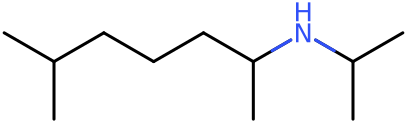
| Molecular structure via molpic based on CDK |
| Physical properties [] | |
|---|---|
| Molecular mass | 171.32 g/mol [1] |
| Predicted LogP | 3.6 [1] |
| Structural Identifiers [] | |
|---|---|
| Molecular formula | C11H25N [1] |
| IUPAC name | 6-methyl-N-propan-2-ylheptan-2-amine [1] |
| SMILES | CC(C)CCCC(C)NC(C)C [1] |
| InChI | InChI=1S/C11H25N/c1-9(2)7-6-8-11(5)12-10(3)4/h9-12H,6-8H2,1-5H3 [1] |
| InChIKey | NKGYBXHAQAKSSG-UHFFFAOYSA-N [1] |
Iproheptine (also known as Iproheptina, Metron S, Iproheptinum, N-Isopropyl-1,5-dimethylhexylamine, NSC-760441, Einecs 237-726-4, Metron s, Dtxcid6026248, NSC 760441 or 237-726-4) is a sympathomimetic substance of the amine class.
Chemistry
Salts []
Iproheptine is typically found in the form of its hydrochloride salt.
Stereochemistry []
Iproheptine is a racemic mixture of the enantiomers.
| Stereoisomerism |
|---|
| Stereoisomer enumberation with rdkit |
Subjective effects []
See also []
External links []
References []
National Center for Biotechnology Information. PubChem Compound Summary for CID 19917, Iproheptine. Accessed August 22, 2026. https://pubchem.ncbi.nlm.nih.gov/compound/19917
U.S. Food and Drug Administration; National Center for Advancing Translational Sciences. Iproheptine. UNII: P021X7VTG0. Global Substance Registration System. Accessed August 22, 2026. https://gsrs.ncats.nih.gov/ginas/app/beta/substances/P021X7VTG0